Washington quarterback Demond Williams Jr. has officially entered the NCAA transfer portal, a move that has quickly become one of the most closely watched developments of the college football offseason. The decision drew immediate attention not only because of Williams’ role in Washington’s future plans, but because of the timing. Williams had recently indicated his intention to return to UW and was reported to have agreed to a deal tied to that return before entering the portal.
Williams entered the portal with a do not contact designation, which prevents other schools from initiating communication unless the player reaches out first. While not uncommon, that designation often leads to speculation around whether a player may already have a preferred destination. In this case, it prompted questions around whether any conversations with outside programs may have occurred prior to Williams officially entering the portal.
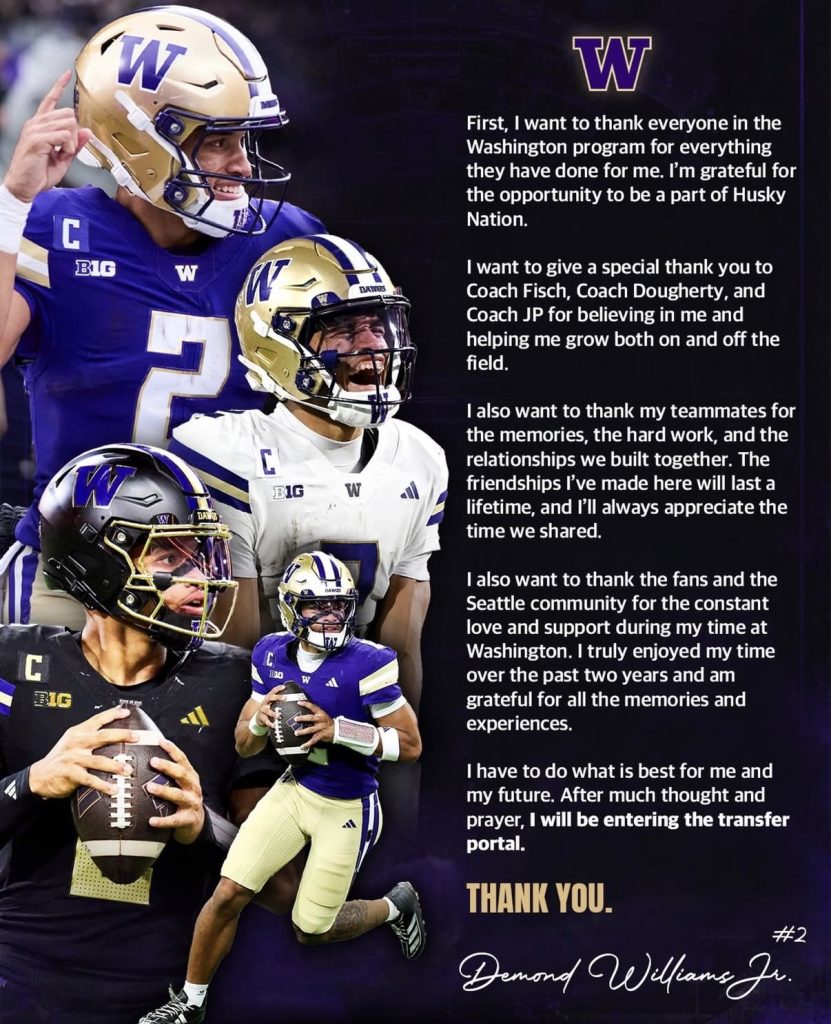
According to multiple reports, Washington is now prepared to explore potential legal options related to the situation. The university is believed to be reviewing the agreement Williams signed and determining whether its terms were violated. In addition, Washington is reportedly examining whether any outside parties such as other programs, NIL collectives, boosters, or representatives may have engaged in improper contact while Williams was still under agreement with the school.
If such contact occurred, it could raise concerns beyond standard NCAA compliance matters. Legal experts have noted that interference with a signed agreement could fall under contract law rather than NCAA enforcement alone, which would place responsibility on third parties rather than the athlete himself. Washington has not publicly confirmed any specific allegations but has signaled it is taking the matter seriously.
The situation underscores the evolving challenges of the NIL era, where roster movement, private agreements, and NCAA regulations increasingly overlap. While transfer rules are governed by the NCAA, NIL contracts are typically handled through collectives and external entities, creating legal gray areas that schools are still learning how to navigate.
Williams remains in the transfer portal and has not publicly announced his next destination. As the situation continues to develop, programs across college football will be watching closely, as any legal action or resolution could influence how NIL agreements and potential tampering situations are handled moving forward.